The following is an excerpt from my book Harmonic Processions.
The traditional music‑notation system, as it has been handed down for centuries, was created with performers in mind, and in that role it has served adequately. One could criticize the challenges posed by multiple clefs, elaborate key signatures, or transposing instruments, but at this point little can be done to improve the widely adopted conventions of the five‑line staff. For composers and music theorists, however, traditional notation presents a different kind of challenge. Their fluency in reading and writing is not in question; rather, it is the staff’s very design that limits harmonic exploration.
Consider the notation of two enharmonically equivalent chords: the all-trichord hexachord on F# and the same on G♭ (120#, F 6-Z17A) (below). They represent the same sonority, yet appear vastly different on the staff. Once these chords are notated in an orchestral score with transposing instruments, their harmonic analysis becomes an exercise akin to solving a Rubik’s cube.
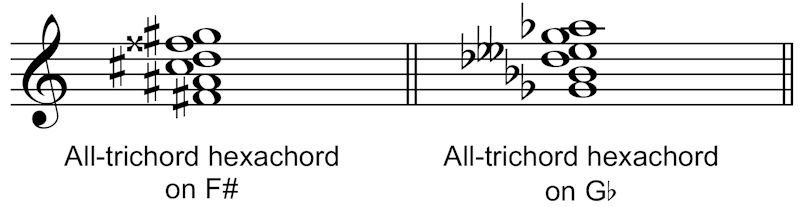
This example represents advanced harmony, but even a simple sonority—such as a major triad—can appear in multiple visual variants in music notation (with sharps, flats, double‑sharps, double‑flats, on the lines, between the lines, etc.). In other words, because the staff offers no single visual representation of a sonority, immediate harmonic analysis is obscured.
There are shorthand systems—Baroque figured bass, the Nashville number system, or the jazz/pop chord‑symbol tradition—but all are rooted in the chromatic model, which is antithetical to comparing quintal relationships. While these systems allow us to circumvent the staff, they fall short of conveying immediate harmonic insight when dealing with more complex sonorities.
The construction of the piano keyboard, likewise designed for performers rather than theorists, presents its own obstacles when analyzing harmonic relationships, yet historically has been used to teach music harmony. On the keyboard, the white keys feel accessible and immediate, while the black keys introduce friction—obstacles to be navigated rather than neutral pitch locations. A C‑major chord has a different physical shape from the E♭‑major chord. We accept this reality, memorize hand positions, and patiently practice arpeggios, yet transposing a passage or analyzing it harmonically requires significant intellectual effort, even for seasoned musicians.
Traditional notation, traditional and modern number systems, and the design of the keyboard—and indeed all musical instruments—obscure harmonic overview and constrain the free exploration of harmonic possibilities. In addition to this general lack of clarity, the notation system imposes a linear paradigm onto multilayered harmonic structures. When a notation system is primarily melodic and linear in nature, as the five‑line staff is, harmonic thinking inevitably becomes dependent on linear inertia. There is nothing inherently wrong with relying on voice leading, but the world of harmony is too rich and too complex to be confined to the convenient, proximity‑driven patterns encouraged by traditional notation. We do not propose abolishing the tried‑and‑true systems that have served performers, conductors, theorists, and composers for centuries. But we do wish to draw attention to their limitations.
Contemporary composers and theorists have the advantage of computers, particularly MIDI editors and notation software, yet these too are built on linear, chromatic assumptions. MIDI editors are somewhat more egalitarian in treatment of individual notes than the staff notation—especially when the superimposed piano grid is removed—but the underlying chromatic model remains the same.
What is needed is a set of tools that allow for rapid harmonic analysis, in which numeric quintal prime forms (or at least scale degrees) can be color‑coded relative to the reference note—a kind of movable “Do.” With such color application to the note lines on the MIDI grid or to the noteheads in traditional notation software, a major chord would appear consistently the same regardless of its tonality, and any added tones—any change in modality—would be immediately visible through color changes. Imagine the numeric quintal prime form #1,2,5,6,9,10 (the “Ode-to-Napoleon” chord) be immediately distinguishable from #1,2,5,7,8,10 (the Istrian scale) through such color system.
To our knowledge, no such tools currently exist, aside from color‑coding the twelve chromatic notes with a fixed “Do” (Cubase by Steinberg, Reaper by Cockos, and to some degree Dorico by Steinberg and Sibelius by Avid Technology), which is of limited use in harmonic analysis. In an era of advanced computing, it is surprising that such tools have not yet emerged; yet we recognize that the market responds to demand, and the demand comes largely from musicians who are unconcerned with the analysis of advanced harmony.
And so we return to the analogy introduced in the opening chapters and confess a certain envy of architects and the wealth of technologies at their disposal—tools that allow them to envision complex three‑dimensional structures, whether orthogonal or intricately curved, while simultaneously integrating electrical, plumbing, insulation, and HVAC systems, not to mention modeling the movement of the sun and the shadows cast by a building at any hour of the day and any day of the year.
We wish to end on an optimistic note, expressing the hope that the Harmonic Processions theory will inspire visual thinkers and bring new creative possibilities to composers, improvisers, music theorists, and software engineers.
Learn more about Harmonic Processions.