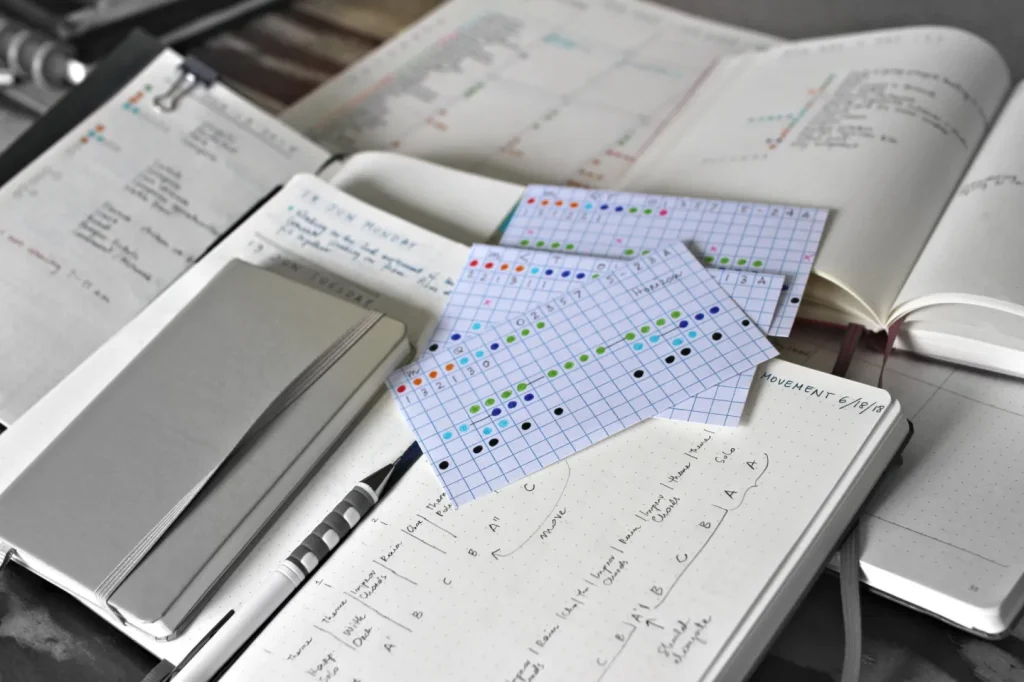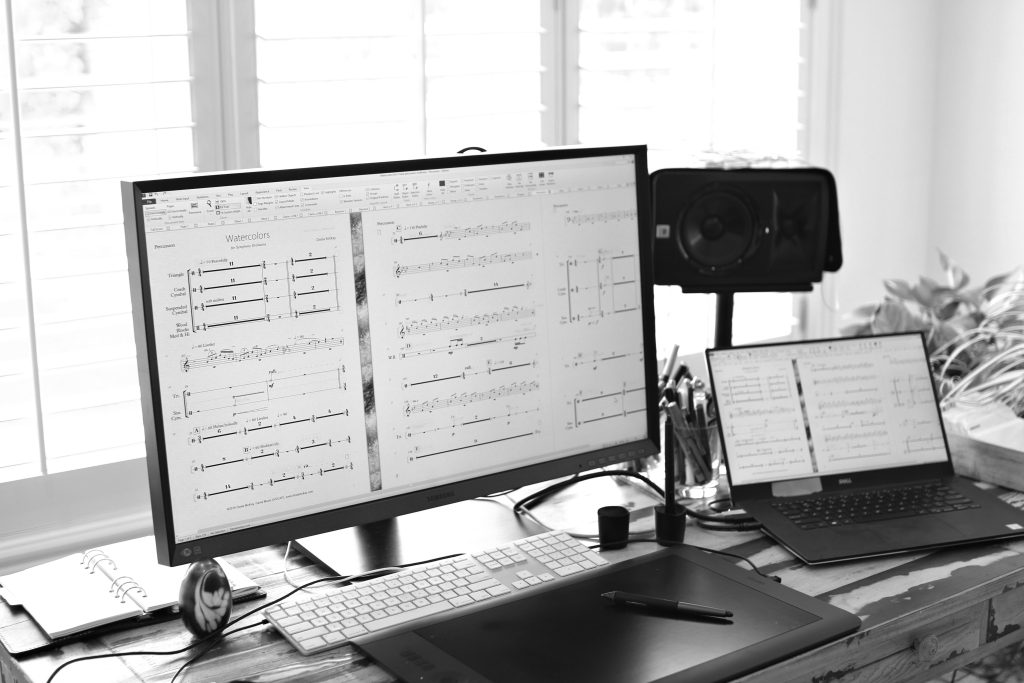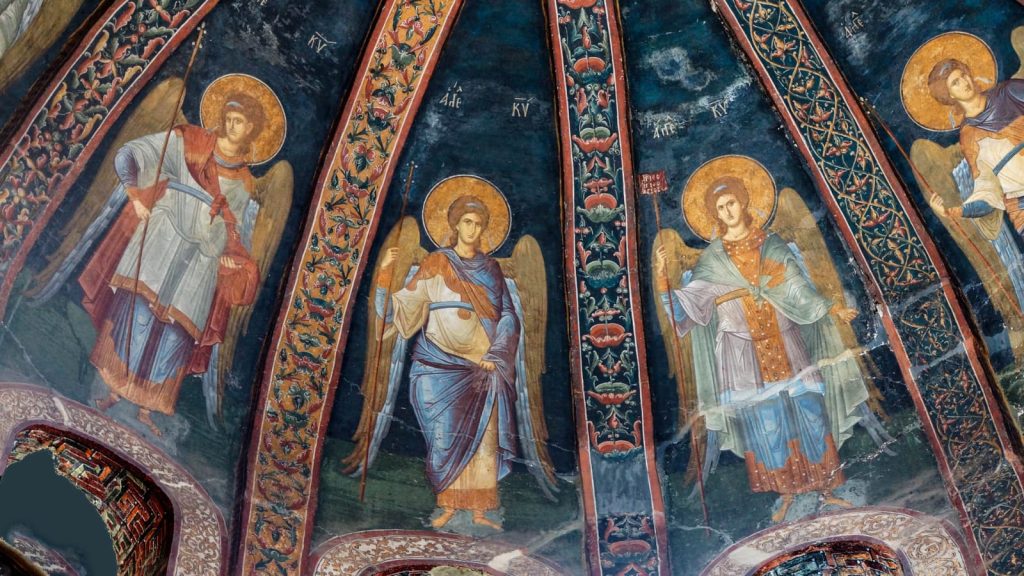
It started innocently with wanting to compose one Cherubic Hymn, but then, before I completed it, an idea for the second hymn came to me and I quickly notated the opening harmonies on an envelope of a bill that lay on the kitchen counter. Later, I began to hear music in my mind for the Great, the Little, and the Augmented Litanies and “Come, Let Us Worship” for the Small Entrance. For those unfamiliar with the matter, these are the ordinary of the Divine Liturgy of the Christian Orthodox Church, sung by an unaccompanied chorus.
I have now completed seven movements and I am making them publicly available to any parish that wishes to include them in their liturgy (https://dosiamckay.com/orthodox-church-music/) and I hope to compose more music in the upcoming months.
As someone who has devoted most of her creativity to instrumental art music that focuses on stretching harmonic and rhythmic boundaries, I find the limits of the liturgical music constraining and intriguing at the same time. There is a predetermined path for me to follow that includes fixed ancient texts and a harmonic scaffolding that must connect the end of one chant (sung by the priest, the deacon, or the chanter) to the beginning of another, in an unbroken flow of a prayerful artistic expression. In practical terms, it means that the harmonies must have clear cadences, the melodic lines must be singable, and the rhythms must be orderly. It is all so straightforward yet quite challenging if one wishes to attempt variety, beauty, excellence, and transcendence.
In my early composition lessons, I was introduced to the concept of self-imposed limits on the creative material. Stated in simple terms, make art with 3-4 elements, discard the rest, and a clear creative pathway will open before you. I felt this acutely when approaching the liturgical music. What could be more constraining than the 4-part harmony and the diatonic scale? Maybe that’s why for the past few months, I have been studying Protestant oratorios and Catholic masses, craving ancient structures that have been the right of passage for many historic and contemporary composers.
The Orthodox Church in America already has a large library of musical heritage handed down to us from the Russian and the Byzantine lineages. I have seen dozens of litanies and communion hymns as I sifted through the thick choir binders of my church, and there are online resources offering multiple variants of the same. Yet, as much as I am enchanted by Alexei Vasilievich Kastorsky’s Cherubikon (check out my version of it on my album Mystical Piano) and Nikolai Kedrov Sr.’s The Lord’s Prayer, as a composer, I feel the need to express these prayers in my own musical language.
There have been discussions within the Church about appropriate musical styles that culturally give voice to our American-ness while preserving our ancient origins, but as a recent convert to Orthodox Christianity, I don’t feel qualified to attempt a comment on these matters. My music education has been too skewed by Palestrina, Bach, Faure, Lauridsen, and Whitacre anyway. I only know that in the Church, there is room for beauty and excellence, and I hope to be a part of it.