The Harmonic Processions Theory
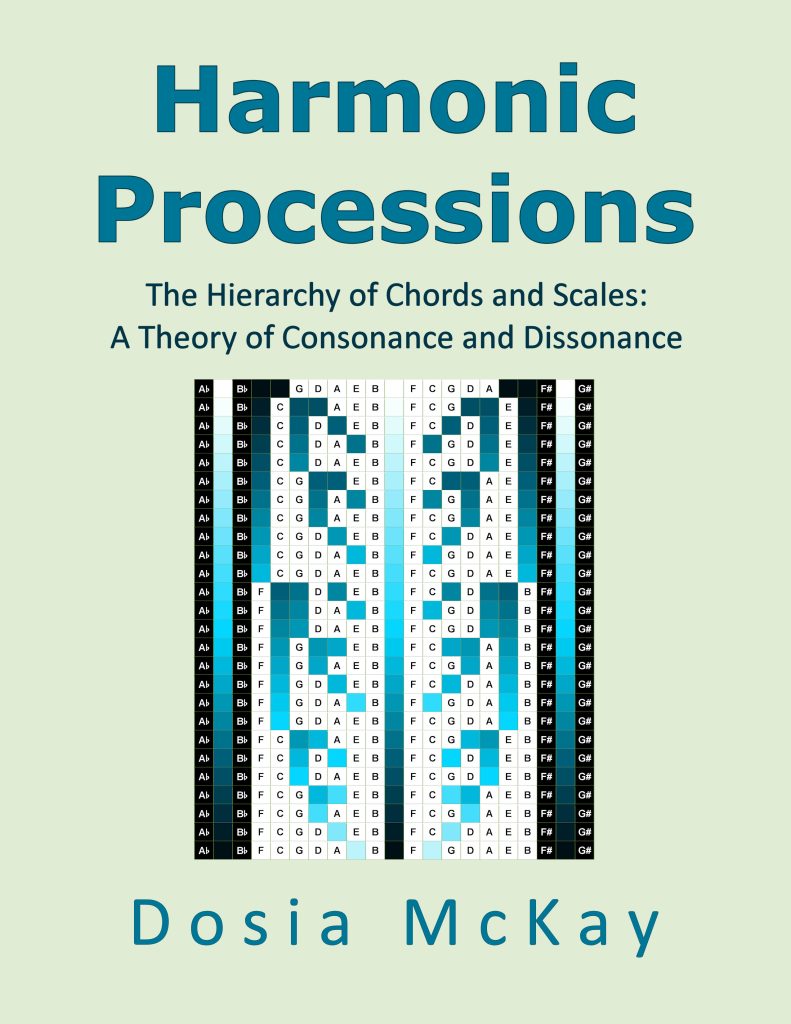
The hierarchy of chords and scales in music harmony
A theory of consonance and dissonance for the modern composer and music theorist
Order now
Printed edition containing all 40 chapters and 48 reference tables
8.5 x 11 in (21.59 × 27.94 cm)
293 pages
$60
Download the free PDF overview of the theory
This is a limited digital edition. The entire system including all 40 chapters and 48 reference tables is available only in the printed book.
About the Harmonic Processions Theory
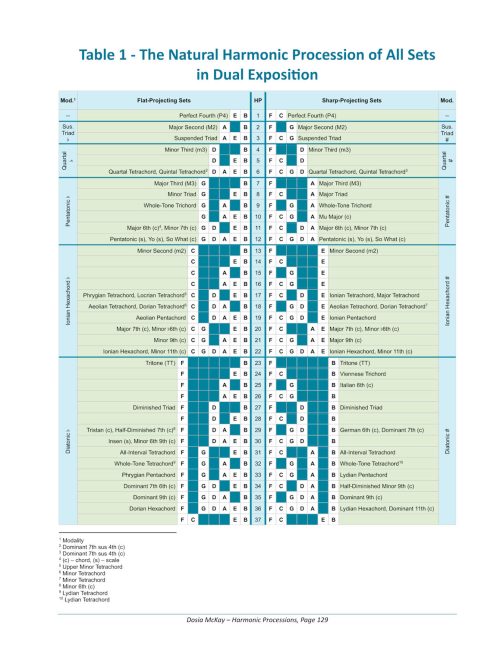
The Harmonic Processions Theory is a system for classifying all 350 possible sets—commonly referred to as chords and scales—found in Western music. The name reflects the system’s structure, in which harmonies process sequentially from simple to complex, revealing shared origins and interrelationships. The processions traverse a gradient from consonance to dissonance, organizing sonorities by distinct harmonic flavors, or modalities.
Guided by mathematical principles, the theory of Harmonic Processions unveils an expressive world that is elegant in its logic. It serves as a powerful tool for composers, music theorists, musicologists, and music‑theory enthusiasts seeking to explore the nature of musical harmony. More than a theoretical framework, it is also a practical reference—a catalog of harmonic swatches, a harmonic color wheel—designed to illuminate the character and potential of all chords and scales.
As we enter the world of harmonic structure, we cannot help but marvel at the sequences and patterns we encounter. The twelve tones of the chromatic scale—like the twelve months of the year, the twelve hours on the clock face, the twelve signs of the Zodiac, the Twelve Apostles, or the twelve hues on the color wheel—point to a mystical visual language echoed in snowflakes under a microscope, in fractals, and in sacred geometry. In this world, we are not the creators; we are merely humble observers.
Why This Book?
Painters have color swatches, color wheels, and gray scales. Architects consult reference books on the properties of steel, concrete, and timber. Chemists have the Mendeleev’s periodic table of elements. But what do composers have to guide their harmonic explorations? How do they find that perfect chord or scale—one suitable for the occasion, not too cliché but also not too jarring—something with a base of vanilla, a touch of melancholy, yet still bright and open?
Music students learn about harmony gradually from various sources. As children, they encounter happy and sad chords (major and minor). Guitarists quickly discover the richness of added 7ths and 9ths, while the pianists devote hours to practicing the harmonic and the melodic minor scales. In college, they meet the pentatonic scale and the diatonic modes. Venturing further—perhaps while playing in a wind ensemble or orchestra—they encounter the octatonic and the whole-tone scales, unlocking yet another layer of harmonic depth.
Many college programs require music majors to take post-tonal theory, a course that dazzles and confounds with interval-class vectors, hexachordal combinatoriality, and transpositional symmetries. Amid this strange and exhilarating landscape, one steadfast element emerges: the list of set classes—the complete catalog of 350 possible chords and scales encountered in Western music. Among them are the familiar major chord and major scale, the Prometheus chord, the octatonic, the chromatic scale, and many others, repeatedly used by composers and dissected by theorists. Still many more remain like distant stars: identified by a number but unnamed and unexplored. With barely a six-digit number (interval-class vector) assigned to each set class, there is little to indicate the character, the modality, the flavor, or the level of dissonance of these sonorities. If the list of set classes is meant to be the composer’s periodic table of elements or a color swatch book, it is not particularly inviting.
Where do composers turn when they want to convey sorrow, bitterness, bliss, curiosity, joy, or ambiguity? Most rely on a mixture of instinct and luck, experimenting with harmonies at the piano until something interesting emerges. Many look to other genres for inspiration. They juxtapose tried‑and‑true harmonic elements in hopes of finding a new angle. Adopting the favorite chords and scales of other composers has long been a standard practice. Yet the fresh sound—the ultimate harmonic progression—often feels elusive, always seeming just out of reach, promising to reveal itself in the next composition. How, then, can composers claim those unnamed distant stars for themselves?
The purpose of this book is to explore every chord and scale and to catalog them in a way that makes their content, qualities, and relationships easy to reference, intuitive to understand, and practical to apply in creative work. If you have ever wished for a color wheel of harmony—a true reference guide to sonic possibilities—this is where your search ends and creativity begins.
How to Use This Book?
This book assumes that the reader is already familiar with basic music theory concepts such as scale, chord, interval, accidentals (sharps and flats), and transposition. The ability to read music notation in both treble and bass clefs is also beneficial. The knowledge of post-tonal theory is helpful although not essential. As more advanced ideas are introduced, they are explained in an accessible manner.
The heart of the book lies in the enclosed tables, which invite the reader to bypass the introductory material and immediately explore new chords and scales through improvisation or composition. However, readers who value a deeper understanding of the theory’s methodology, will find detailed explanations, examples, and exercises in the preceding chapters.
Chapters
1. The Harmonic Processions Theory
2. Why This Book?
3. How to Use This Book
4. Is It a Chord or a Scale?
5. Note and Pitch
6. Enharmonic Equivalence
7. Interval and Interval Class
8. The Overtone Series
9. The Interval of the Perfect Fifth and the Circle of Fifths
10. The Role of the Circle of Fifths in the Harmonic Processions
11. The Triadic Form and Transposition
12. The Row of Fifths
13. Consonance and Dissonance
14. The Magnetism of Consonance and the Repulsion of Dissonance
15. The Resolution of the Tritone
16. Sharp and Flat Projections
17. Span
18. The Quintal Prime Form
19. The Numeric Quintal Prime Form
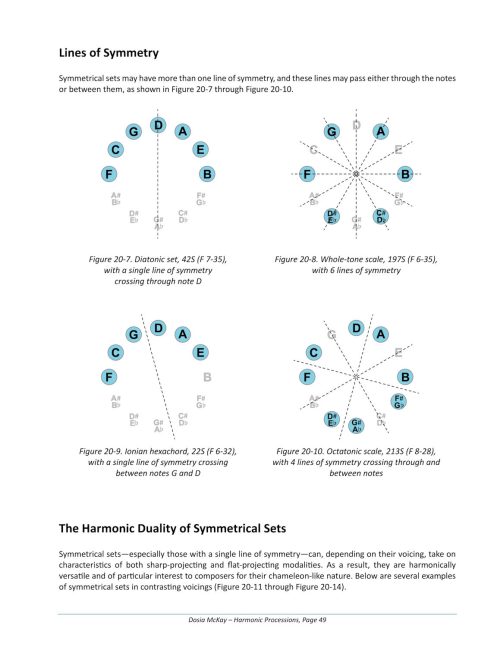
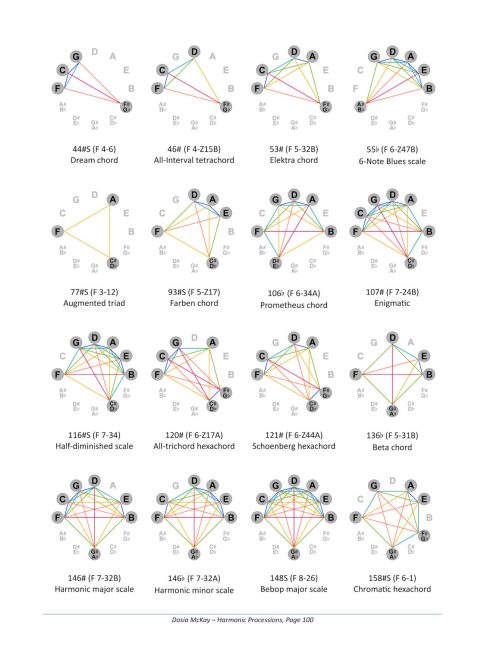
20. Symmetrical Sets
21. Mirror Sets
22. The Natural Harmonic Procession
23. The Natural Order of Sharp-Projecting Sets
24. The Natural Order of Flat-Projecting Sets
25. The Duality of the Natural Harmonic Procession
26. Modalities and the Modal Harmonic Procession
27. Modulation
28. The Natural Harmonic Procession and Dissonance Levels
29. The Interval-Class Vector
30. The Interval-Class Vector of the Diatonic Set
31. The Interval-Class Dissonance Gradient and the Dissonance Curve
32. Quantifying Dissonance Levels of Sets and the Dissonance-Gradient Harmonic Procession
33. The Interval-Class Signature
34. Building and Resolving Harmonic Tension
35. Tonal Ambiguity
36. Z-Relation and Dissonance Level
37. Modal Heptachords, Hexachords, and Pentachords
38. Tritone Substitution
39. The Forte Numbers
40. Further Thoughts
Harmonic Processions Tables
1. The Natural Harmonic Procession of All Sets in Dual Exposition
2. The Natural Harmonic Procession of All Sets
3. The Natural Harmonic Procession of All Sets, Including the Numeric Quintal and the Chromatic Prime Form
4. The Natural Harmonic Procession of All Sets, Including Interval-Class Dissonance Gradients
5. The Natural Harmonic Procession of Sharp-Projecting Sets
6. The Natural Harmonic Procession of Flat-Projecting Sets
7. The Natural Harmonic Procession of Symmetrical Sets in Sharp-Projecting Form
8. The Natural Harmonic Procession of Symmetrical Sets in Flat-Projecting Form
9. The Natural Harmonic Procession of Dyads
10. The Natural Harmonic Procession of Trichords
11. The Natural Harmonic Procession of Tetrachords
12. The Natural Harmonic Procession of Pentachords
13. The Natural Harmonic Procession of Hexachords
14. The Natural Harmonic Procession of Heptachords
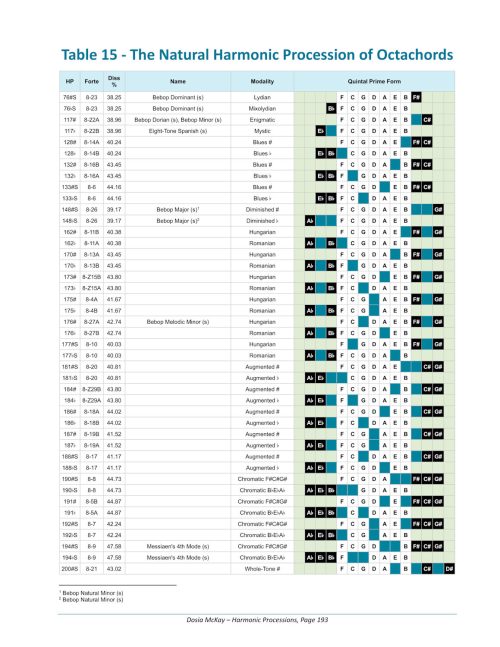
15. The Natural Harmonic Procession of Octachords
16. The Natural Harmonic Procession of Nonachords
17. The Natural Harmonic Procession of Decachords
18. The Natural Harmonic Procession of Undecachords
19. The Natural Harmonic Procession of Dodecachords
20. The Modal Harmonic Procession of All Sets
21. The Modal Harmonic Procession of All Sets, Including the Numeric Quintal and the Chromatic Prime Form
22. The Modal Harmonic Procession of Dyads
23. The Modal Harmonic Procession of Trichords
24. The Modal Harmonic Procession of Tetrachords
25. The Modal Harmonic Procession of Pentachords
26. The Modal Harmonic Procession of Hexachords
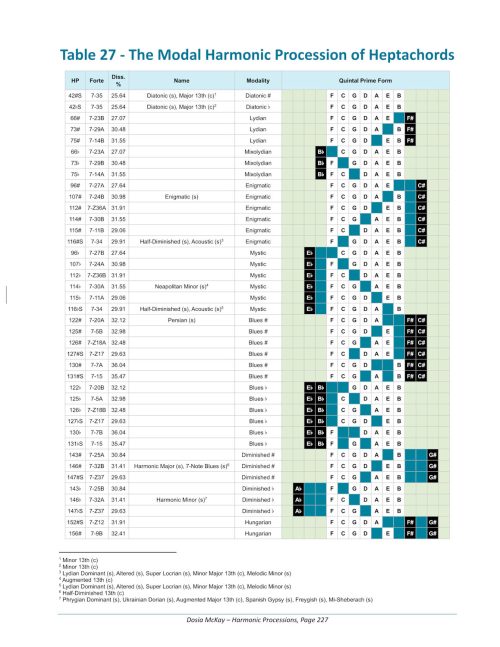
27. The Modal Harmonic Procession of Heptachords
28. The Modal Harmonic Procession of Octachords
29. The Modal Harmonic Procession of Nonachords
30. The Modal Harmonic Procession of Decachords
31. The Modal Harmonic Procession of Undecachords
32. The Modal Harmonic Procession of Dodecachords
33. The Dissonance-Gradient Harmonic Procession of All Sets
34. The Dissonance-Gradient Harmonic Procession of All Sets, Including the Numeric Quintal and the Chromatic Prime Form
35. The Dissonance-Gradient Harmonic Procession of Dyads
36. The Dissonance-Gradient Harmonic Procession of Trichords
37. The Dissonance-Gradient Harmonic Procession of Tetrachords
38. The Dissonance-Gradient Harmonic Procession of Pentachords
39. The Dissonance-Gradient Harmonic Procession of Hexachords
40. The Dissonance-Gradient Harmonic Procession of Heptachords
41. The Dissonance-Gradient Harmonic Procession of Octachords
42. The Dissonance-Gradient Harmonic Procession of Nonachords
43. The Dissonance-Gradient Harmonic Procession of Decachords
44. The Dissonance-Gradient Harmonic Procession of Undecachords
45. The Dissonance-Gradient Harmonic Procession of Dodecachords
46. Sets with Identical Dissonance Levels, Including Z-Related Sets
47. Sets Sorted by Forte Numbers
48. Sets Sorted by Forte Numbers, Including the Numeric Quintal and the Chromatic Prime Form
Copyright ©2026 Dosia McKay. All rights reserved.
This publication is protected by copyright and registered with the U.S. Copyright Office. No part of this publication may be reproduced, distributed, or transmitted in any form or by any means, including electronic or mechanical methods, without the prior written permission of the author, except in the case of brief quotations in reviews or other permitted uses under copyright law. For permission requests, contact the author at www.DosiaMcKay.com.
ISBN 978-1-7341225-5-8
Library of Congress Control Number: 2026908898
Cover, interior design, and illustrations by the author
Published by Gavia Music, Knoxville, Tennessee, 2026
Printed in the United States of America